


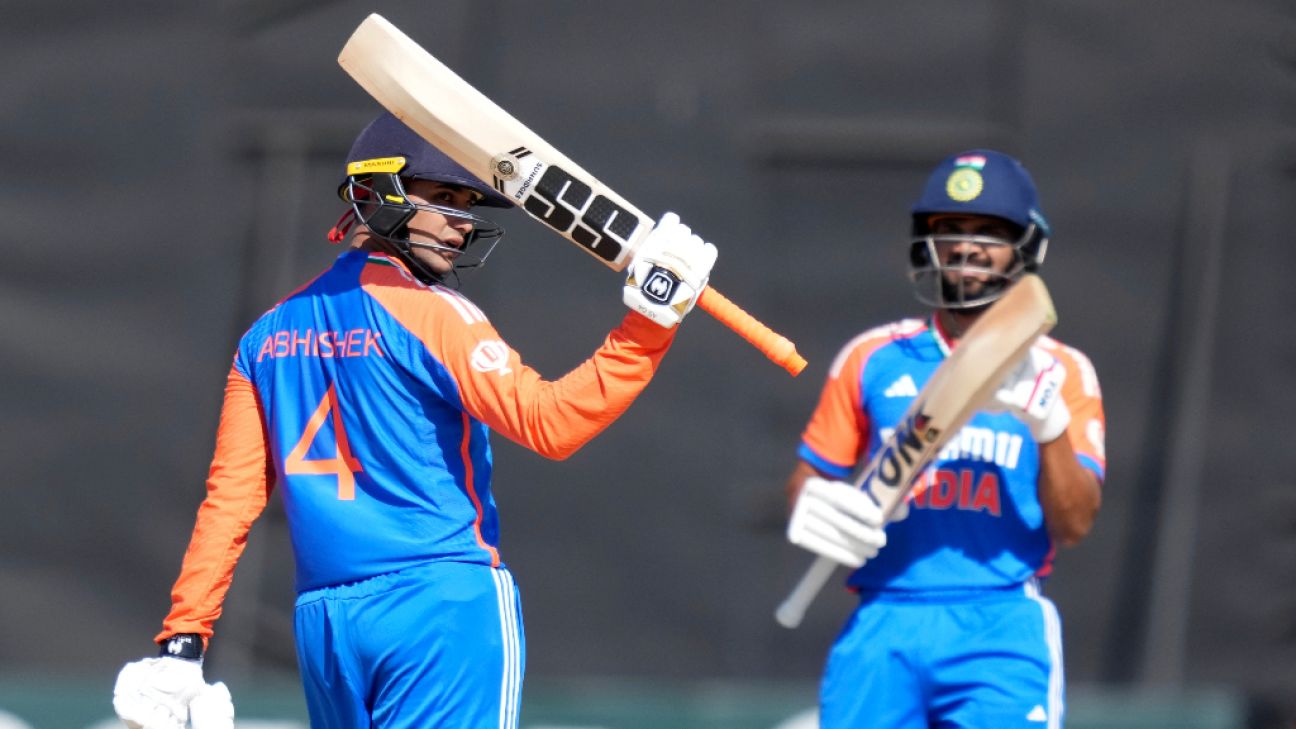
India 2 for 234 (Abhishek 100, Gaikwad 77*, Rinku 48*) Beat Zimbabwe 134 (Madhavre 43, Avesh 3-15, Mukesh 3-37, Bishnoi 2-11) by 100 runs
A misleading start
On Saturday, Zimbabwe had opened bowling with Brian Bennett, deployed his offpin against India’s left-handed debut, and brought more wicket-medane than before for a duck with Abhishek. After batting India, India distanced the same match-up from the second T20 Eye, and Abhishek pulled out for six from the first legal ball in international cricket and made a mark in international cricket.
This was an indication of what was to come, but it was not. International cricket is not necessary better Standard compared to IPL, but it can be very different. It was a Harler pitch with a slight bounce and the seam quickly, and the Zimbabwe’s attack used it well in the powerplay to keep India up to 36 for 1.
Shubman Gill fell in the second over, blessing Mujrabani directly to mid-on, and was the best bowler from Zimbabwe in the early stages, especially harassing Ruturaj Gikwad with his lift and movement in the corridor. Abhishek took time to get caught up even with circumstances, and was batting for 27 off 23 balls at one point.
Then he looked at his front leg to clean and hit the medium-motion at the top of Luke Jongve, and highlighted it in the air on the middle-band area. Wellington Masakadza was found below it, and placed it down.
Abhi shakes the room
From that time, Abhishek was invincible, scoring 72 runs in his last 23 balls at the crease, hitting five fours and seven sixes at that time. Suddenly, conditions stopped to bother him. He was rocking back on a little short balls and pulling with terrible power. He was stepping out and freeing his weapons for scaffolding for brilliantly covering. A minor Zimbabwe attack, suddenly, seemed to see what it was.
On the way, he left a couple of bowlers nursing Vivid Bruz. The slow-medium of Donon Myers 4, 6, 4, 6, 4 disappeared in the 11th over, the hits of a demon bridge that hit the roof beyond the leg-side border to bring fifty of Abhishek. Then Masakadza, both unfortunate, demolished both Abhishek and went to a purification of the left -handed orthodox, went for 6, 6, 6 in the 14th over – the last of them was a swipe with a swipe on the backward class leg, which brought in the century of Abhishek – a variety ended before the next bowler.
Gaikwad and Rinku Stack it
Or not, because Zimbabwe still had six overs bowl and India was now in mood. Gaikwad’s struggle against the circumstances and the war of playing their first competitive cricket since the IPL expanded their 38th ball in all ways when he brought fifty with four to four from Jongve. In the next over, he separated Chata in 18th, killed him for three fours and a six eventually scored 47 runs unbeaten on 77.
However, the main source of India’s end -overs carnase was Rinku Singh, who was inauspicious to remember his World Cup campaign, while the squad was announced. He was in his element here, was promoted to number 4 with the right entry point for his skill, slapping the sixth ball to charge six on the cover and completed the innings with four and back-to-back sixes from Jongve, which ended with 53 figures in four overs. When he motivated Abhishek to do wrong at 27, he might have guessed.
Mukesh, Avesh and Bishnoi wrap it
If Zimbabwe had any hope of going to his chase, it is in the creation of India’s attack. After selecting the additional batsman, they were playing only four frontline bowlers, leaving four overs to complete by Part-Timer Abhishek and Ryan Parag.
Abhishek is not a part-time in domestic cricket, and there are a lot of changes to go with his stock left-arm orthodox, but he found that in an international game Powerplay may have difficult bowling, an aggressive mood accepted 19 with Bennett in an aggressive mood. Bennett caught Mukesh Kumar in the next over, killing him for a pair of back -to -buc sixes on a large scale – on the square leg and then under the ground – but he fell on the next ball.
This second wicket was taken with Mukesh with an in-world, to bowl innocent body through the gate in the first over after another. Such a seam movement, in which slightly inconsistent bounce was thrown, was a defined characteristic of Zimbabwe’s powerplay: he scored 22 runs compared to India at that stage, thanks to Bennett’s aggression, but he lost four wickets for India.
One of them stated how challenging it was to challenge the situation: Alexander Raza a bouncer of Avesh Khan Skiding, as he took shape to hook, forcing him to close the gloves.
Zimbabwe’s innings continued to hoist after the powerplay, with Ravi Bishnoi-especially excellent looking-the Chennathan Campbell, comprehensive and reverse-sweeping with rising frustration, failed to bat on five gradual balls, and extended the sixth in his body. Wesley Madhavre batted in all ways from the beginning of Chase to the 17th over, and scored 43 runs in 39 balls. Zimbabwe was eventually dropped out for 134 with eight balls, with Mukesh and Avesh finish with three wickets and Bishnoi with 2 of their four overs.
Karthik Krishnaswamy is an assistant editor in Espncricinfo

Leave a Reply